Draw the useful route first
List the places you actually need to reach: the back door, shed, compost area, washing line, growing beds and a seat. Connect those destinations before drawing decorative loops. A direct working route can sit comfortably beside a slower garden walk, but a forced curve across the line you always take is likely to acquire a muddy shortcut.
Use a hose or temporary markers to test the line at full size. Walk it with tools and try the tight turns. Consider who will use the path now and later, including people with reduced mobility, pushchairs or walking aids. A route that looks generous on a sketch can feel narrow once plants lean over it.
Use the view to invite movement
A path does not need to reveal everything at once. An arch, an offset planter or the visible end of a bench can suggest a destination without blocking passage. At Great Dixter and Barnsley House, planting and hard landscape offer useful examples of how routes relate to surrounding borders. Observe the relationship, rather than copying a surface without understanding its maintenance.
Keep the walking line legible. A little self-seeding at an edge can be charming, but an obscured step or a trail of stones across a dark surface is a different matter. Decide which planting can spill safely and which needs regular trimming. Leave access for that work.
Choose a surface for its users
| Surface | Character | Watch for |
|---|---|---|
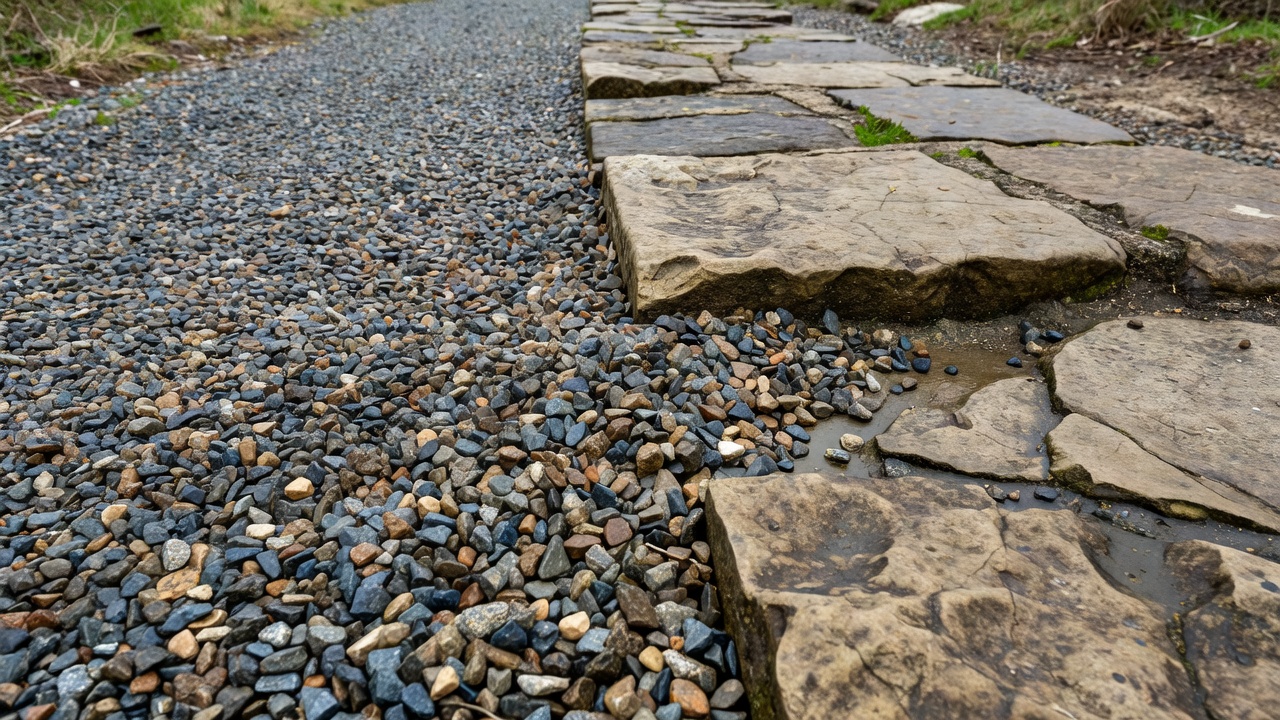
| Natural stone | Variation, texture and long-term patina | Uneven pieces, wet slip resistance and appropriate installation |
| Loose gravel | Informal appearance and adaptable outline | Migration, raking, slopes and difficulty for small wheels |
| Brick or clay pavers | Warm colour and repeated pattern | Outdoor suitability, frost resistance and joint maintenance |
| Stabilised aggregate systems | A more contained aggregate surface | System-specific base, access performance and upkeep |
No surface is automatically accessible because it is described as natural or permeable. Firmness, stability, gradient, crossfall, joints and maintenance all matter. Loose gravel may be unsuitable for a primary route used by a wheelchair or walker. Obtain access-specific guidance where needed and test material samples under realistic conditions.
Look below the finished surface
The visible stone is only one part of a path. Ground preparation, the supporting build-up, edge restraint and drainage affect how it performs. There is no single base specification suitable for every soil and loading condition. A pedestrian garden path, an occasional vehicle crossing and a route over disturbed ground require different consideration.
Do not lay over inspection covers or bury access points simply to preserve a pattern. Check underground services before excavation and respect tree roots. If roots are present, seek appropriate arboricultural advice rather than cutting them to suit a preferred line. Moving the path can be the better design decision.
Give rain a considered destination
Visit the proposed route during or after rain. Identify low spots and existing runoff before deciding on levels. Water should not be casually redirected toward a house, neighbouring property or public route. Permeable-looking materials do not guarantee a permeable construction, especially over compacted ground or an impermeable base.
Changing levels near a building can create problems with damp protection and ventilation. Where a path meets the house, a drain or a retaining structure, ask a competent installer to assess the detail. Local rules may also affect drainage and paved areas. General inspiration should not replace that check.
Finish the boundaries, then maintain them
Edge restraint keeps loose material where it belongs and supports a clear line. Choose an edge that can be maintained without a constant battle with the mower or border plants. Avoid projecting corners and abrupt lips in the walking route. Changes in material should be comfortable to cross and easy to see.
Regularly clear leaves, manage algae and remove growth that makes the surface slippery or hides defects. Use cleaning methods compatible with the material and its joints. Aggressive washing can damage soft stone, strip jointing or disturb surrounding soil. Repair loose pieces and settlement rather than treating them as harmless rustic character.
Finally, place the seat or focal point and walk the route again. A good path ends somewhere useful, with room to turn, pause and return. That small piece of choreography is as important as the colour of the stone.