Begin with the threshold
Walk your garden from the door you use most often. Notice where its character changes: from paving to planting, from open lawn to a narrow path, or from working beds to a quieter seat. These transitions are natural places for an arch. A structure dropped into an unrelated patch of lawn may look attractive in isolation yet do little for the journey.
Mark the proposed uprights and walk between them carrying the things you normally carry. Remember that a bare frame is only the starting opening. Rose stems, hanging shoots and vigorous summer growth will occupy some of that space. Plan comfortable passage with the planting maintained, rather than expecting visitors to squeeze past thorns.
Match the structure to its role
| Structure | Best role | Main trade-off |
|---|---|---|
| Garden arch | A distinct entrance or crossing | Growth can narrow the opening |
| Pergola | A repeated overhead route or seating space | More structure, anchoring and maintenance |
| Decorative trellis | A planted screen or boundary layer | Requires suitable supports and pruning access |
A pergola need not be covered completely to feel settled. Repeated posts and beams can provide enough rhythm, while lighter planting preserves sun and air. Conversely, a densely planted pergola may become darker, wetter and more demanding to maintain than its owner expected. Consider winter appearance as well as the midsummer photograph.
Let the climber influence the frame
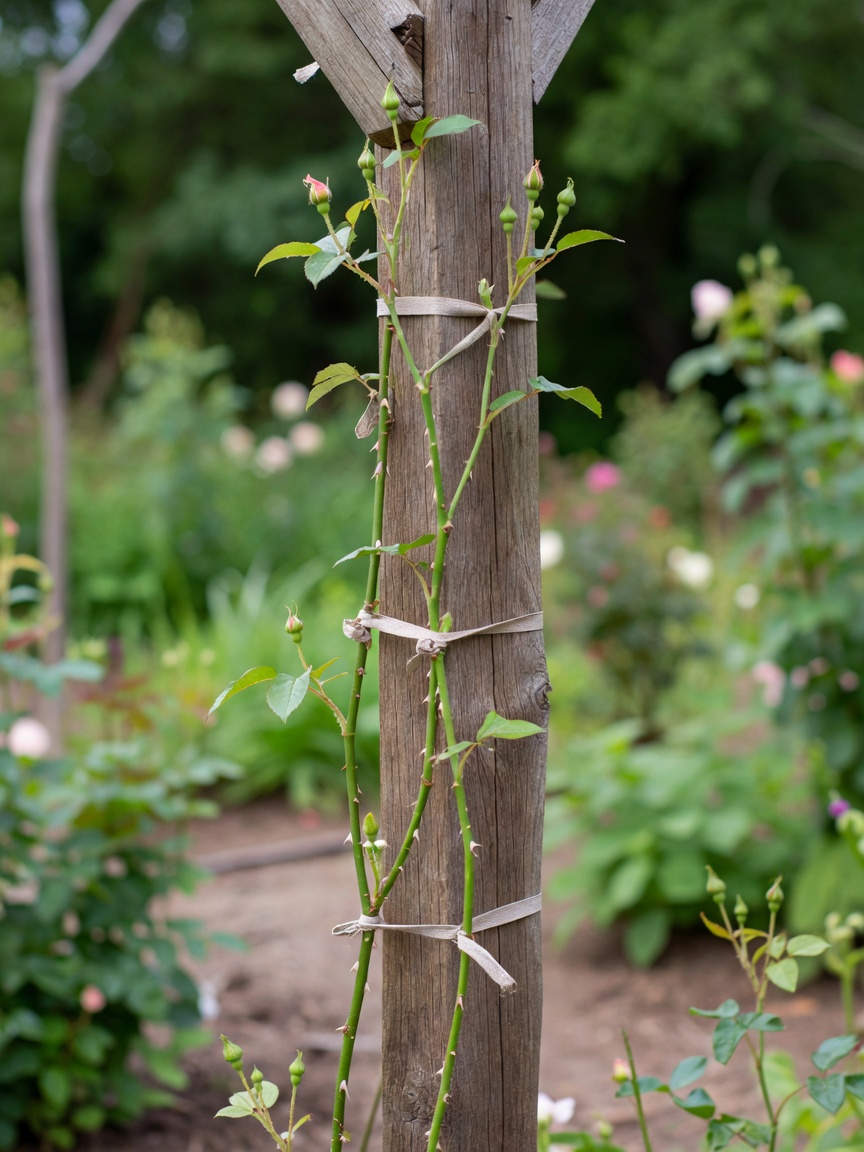
Climbers attach themselves in different ways. Roses usually need tying and training; clematis uses leaf stalks to grasp suitably slender supports; wisteria develops substantial woody growth. The Royal Horticultural Society publishes plant-specific training and pruning guidance, which is more useful than treating all climbers as interchangeable decoration.
Choose the plant and support together. A delicate decorative panel may suit a modest seasonal climber but should not be assumed capable of carrying a mature woody specimen. Wet foliage adds weight, and growth increases the area exposed to wind. Ask the supplier about the intended loading and installation requirements. For substantial structures or uncertain conditions, obtain competent site-specific advice.
Think about the boundary behind it
A trellis placed slightly forward of a boundary can create useful planting depth, but the supports still need a sound fixing arrangement. Do not assume an existing fence, wall or neighbouring structure can take the additional load. Establish ownership and permission before attaching anything, and allow for access to the surface behind the plants.
At gardens such as Sissinghurst Castle Garden and Hidcote, thresholds and changes of enclosure contribute to the experience of moving between spaces. The transferable lesson is the sequence of views, not the scale of the structures. A modest garden can use one well-placed opening and a glimpse of a bench to achieve a similar sense of invitation.
Choose materials you can maintain
Timber offers a warm, easily planted-against surface, but joints and moisture traps deserve scrutiny. Galvanised steel can create a finer outline, though coatings, cut edges and fixings need suitable protection. Painted metal provides a strong visual line; chips and corrosion should be addressed before they spread. Compare repairability, not simply the finish on delivery.
Keep plant ties away from sharp edges, inspect contact points and avoid allowing stems to become tightly bound around vulnerable details. If repainting will require removing years of growth, consider that inconvenience before buying. A structure should remain serviceable after it becomes part of the planting.
Check the ground before the post hole
There is no universal foundation size for every arch or pergola. Soil, exposure, dimensions, loading and the installation system all matter. Locate underground services, understand nearby drains and roots, and check local planning or building requirements where relevant. Follow manufacturer instructions and seek professional advice when the design or ground conditions exceed your experience.
Finish by planning an inspection route. You should be able to examine the bases, reach ties, prune growth and replace a damaged component. That small allowance for future work is often what separates a lasting garden feature from a difficult repair.